
The Belly-Button Gap
My two-year-old did exactly what I asked. That was the problem.

My two-year-old was at the dinner table the other night, working through chicken nuggets and carrots. Working through the nuggets, anyway. The carrot he was mostly playing with.
He pointed at his stomach. I took the opening. “Good job, buddy. Now let’s put the carrot in our belly.”
In my head the logic was airtight. Eat the carrot, it goes down, it ends up in your belly. A clean little cause and effect I was sure he’d follow.
He picked up the carrot and pressed it, firmly and with total commitment, into his belly button.
He did exactly what I asked. That’s the part I keep coming back to. He wasn’t ignoring me, wasn’t resisting, wasn’t being two. He had full buy-in. He took my instruction, ran it through the only model of the world he had, and executed with confidence. The carrot was going in the belly, and as far as he could tell, the belly was right there in the middle of him with an obvious way in.
The breakdown wasn’t intent. It was translation. And I didn’t see it coming, because everything on the surface looked like agreement. He nodded, he reached for the carrot, he acted. By every signal I was reading, the message had landed. Right up until it didn’t.
Strip it down and this isn’t about toddlers. Communication doesn’t transfer meaning. It transfers symbols (words, tone, a pointed finger) that the other person decodes against their own context. “Put the carrot in your belly” was never one message. It was two: the one I encoded and the one he decoded. They overlapped just enough to feel like understanding and split exactly where it mattered. That space between the message you send and the message that arrives has a name now, at least in my head: the Belly-Button Gap. And the more confident and willing the other person is, the longer it stays invisible, because compliance looks identical to comprehension until the work comes back.
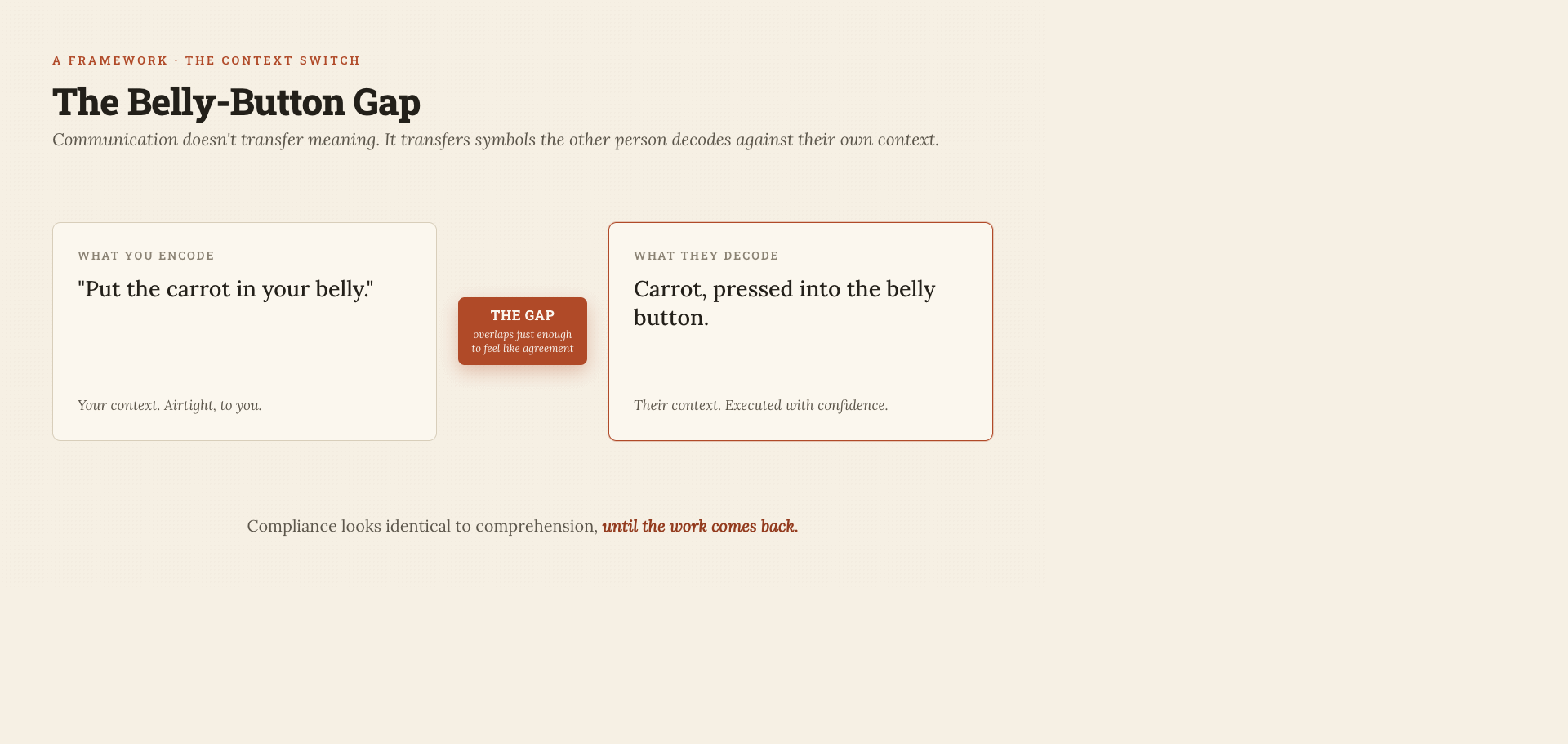
There’s an old distinction between what you control and what you don’t. I can control the signal I send. I can’t control the model it lands in. Which puts the burden of being understood on me, not on the listener. Treating it any other way is just resentment with a head start.
I lead on the technical side of enterprise sales, where one misread requirement can cost a team days. Any leader who’s handed off work they cared about knows this scene. You give it to someone sharp and motivated, someone who wants to nail it. They nod. They take notes. They go build. And what comes back is a carrot pressed into a belly button: a confident, competent execution of a thing you never actually meant. The first instinct is to wonder what they missed. The honest read is usually the reverse. I encoded for my context, they decoded in theirs, and I mistook the nod for a shared model. The mismanaged expectation was mine, for assuming the message I sent was the message that arrived.
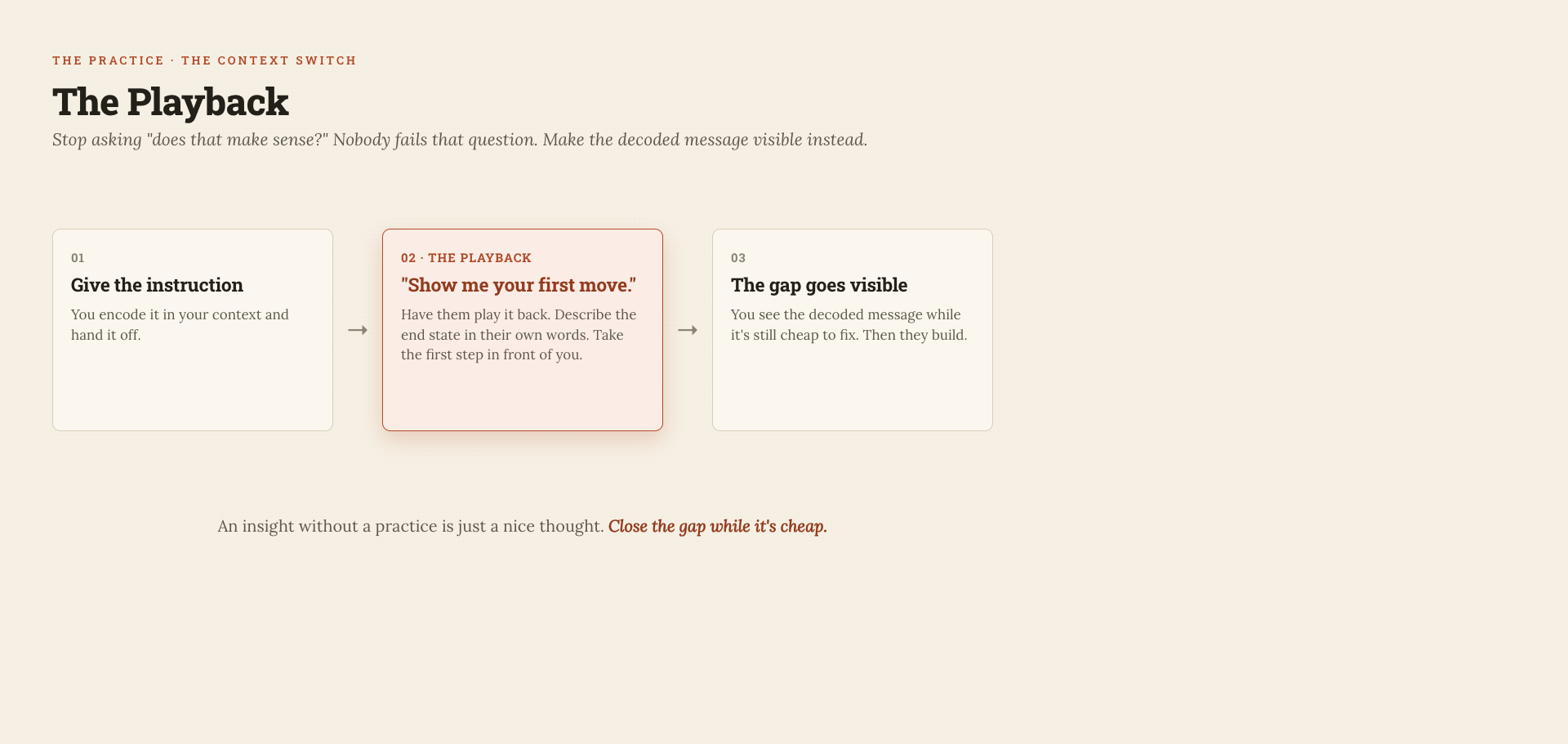
So here’s the practice, because an insight without a practice is just a nice thought. Stop treating “does that make sense?” as the check. Nobody fails that question. The real check is: show me what you’re about to do. Have them play it back. Take the first step in front of you. Describe the end state in their own words. Make the decoded message visible before any real work rides on it. Call it the Playback. At the dinner table it’s pointing at his mouth and saying “carrot goes here.” At work it’s “walk me through your first move before you build.” Same move. You’re closing the gap while it’s still cheap to close.
My son is going to teach me more about leadership than most leadership books will, and he has no idea he’s doing it. That’s the part I didn’t expect about stepping into this kind of role: the curriculum isn’t at work. It’s at the dinner table, and the lesson is always the one I thought I’d already learned.
What’s your carrot-in-the-belly-button moment, the time someone did exactly what you asked and it still came back wrong? I read every reply, and the best ones end up teaching the rest of us. Tell me about it.